Monday, May 22, 2006

Simla:A Breif History Of The Queen Of Hills


(Source:The Tribune)
WHEN Charles Pratt Kennedy was deputed in 1822 as Superintendent of the Hill States, could he have imagined that he was destined to initiate the founding process not only of a new town in India but of a way of life that would remain the focus of socialite attention throughout the 19th century? The British in India had called Shimla by various names — Viceroy’s Shooting Box, Abode of the Little Tin Gods and even Mount Olympus.
Shimla was formally acquired by the British in the tenure of Lord William Bentick. But it was during Lord Aucklands’ time that Shimla began to come of age. A report of 1839 states that most European products, ranging from fine fabrics to French sauces, Scot sardines, English sweets and even fine horses were all available in Shimla. There being no roads worth the name, the only mode of travel was the jampans for ladies and horses for men. The jampan was a kind of chair, usually covered and attached to two or four small poles and lifted on the shoulders by two or four men. Wheeled carriages were not allowed or were not feasible in Shimla till as late as 1840s.
Yet Shimla’s reputation as a place for pleasure-seekers developed almost with its foundation. "The presence of unattached ladies, bachelors, flirts, match makers gave to Simla its early reputation.... Early evenings on the Mall, was the customary place for building acquaintances.... Eligibles... socially desirables... all were on the Mall."
Lord Dalhousie (1848-56) spent two seasons in Shimla but did not quite like it. In a letter he wrote: "This place has been greatly overrated in climate and everything else." After the Mutiny of 1857 had been settled, Shimla was home to a large number of injured and sick British troops. Like Dalhousie, even Lady (his successor’s wife) Canning found Shimla’s beauty "rather questionable... every road has a khud."
Peterhoff (1880)Of Shimla’s social life in the middle of the 19th century, the famous Times (London) reporter Howard Russel wrote (June 14, 1858): "Social distinctions are rigid... each man’s status was entirely depended on his rank and office... women were totally dependent for their own position on their husbands and neither wealth, wit, nor desirable connections could break through the barrier." So ambition bitten were the bureaucracy that a common joke in the 1860s was: "You cannot sleep in the night in Simla because of the noise of the ‘grinding of axes’."
It was the foresightful Sir John Lawrence who recommended to his Home government the idea of making Shimla the summer capital of the Government of India. Surprisingly his relevant minutes make no mention of Shimla’s beauty: "Here you are with one foot in Punjab and another in the North West Frontier. Here you are among docile population and yet near enough to influence Oudh." Some years earlier, Dalhousie had already initiated a proposal to build a road to Simla. The concept of the Hindustan Tibet Road is in fact credited to Dalhousie. Of the proposed road, which became the Cart Road at Shimla, Dalhousie wrote: "It will not be surpassed by any mountain road in the world."
The tone of Shimla’s social life in the 19th century was normally set by the Viceroy and his lady. The early social circuits mainly included wives of officials who were posted in the field, officers from cantonments and, in due course, rich English businessman from Calcutta. A drama club came into being in 1840. Well before the end of the 19th century, Annandale had become famous across British India for its fetes and fairs and women’s archery competitions.
A grand railway bridge (1903)Peterhoff, the Government House, was occupied for the first time in 1876 by the fashionable Viceroy couple, the Lyttons. Peterhoff developed a reputation for hospitality, particularly for the quality and quantity of exotic drinks served there. Its lunch menus took much time of the society gossip. The Gaiety Theatre opened in 1838 but it was Lady Lytton who brought it of age almost 40 years later. In 1887, the new Gaiety Theatre opened in the Town Hall building.
The site for one of main landmarks of Shimla — the Viceregal Lodge — was chosen by Lord Lytton. There is a story of how Lady Lytton was so impressed by the beauty of the place and how she influenced Lord Lytton. The site had until then been known as the Observatory Hill (named after the observatory built by Col Bouileau in 1844). Records relating to the construction and other details of the building are mind-boggling.
Annandale (1895)Amazingly, just as today, extensive construction in Shimla had become a cause of worry as early as 1901. "The Public works and other buildings have made Simla monstrous", Curzon noted. "Too bustling... too public... pomp to irksome, it is like dining everyday in the house keepers room with the butler and the maid."
Curzon began escaping to the Retreat, and then to his new found love Naldehra. The other Viceroys treated Shimla as a holiday break, but Curzon, a workaholic to the core, did the opposite. He took along to Shimla his sensitive files. It was at Naldehra that Curzon penned some of his memorable minutes. Sitting and dining in the open. Walking the slopes, all the while thinking. All the time in touch. At Naldehra, he even installed a complex communication system of relaying messages to Shimla by heliograph during the day and flashing lamps at night. By the turn of the century, Shimla had lost most of its famed wildlife. The golden eagle was rarely sighted after 1900, and the leopard too had disappeared.
The Town Hall, Church and Jakhu Hill in the backdrop (1902/3)In November, 1903, Shimla was connected by the Railways. It was a monumental event that changed Shimla for ever. Within a year, Shimla added 1400 new cottages. Hotels like Cecil, Grand, Metropole followed in their modern form. Within five years of the coming of the Railways, the summer time population of Shimla had averaged to 38,000 — of whom 7000 were Europeans. Among the first non-official permanent residents were the members of the Dyer family who then owned the brewery at Solan.
The tradition that made Shimla stand apart as a town of clean orderliness, a tradition that continued up to the time of Dr Y.S. Parmar’s exit from power, was started by Curzon. The surest way to rouse Curzon’s temper it was said was to litter the road or the hill side. It was Curzon who initiated with rightful fanaticism the policy of upkeeping and special care of old buildings.
The Shimla railway line (1903)By the early years of the 20th century, Shimla had emerged as a ‘decent place’ to retire. Of how the retired spent their time, a letter reads:
"He rises early.... Six newspapers to read, forty Madras cheroots to smoke.... A kindly tiffin to linger.... A game of billiards... 12 pegs to drink... band on the Mall, dinner, chatter.... Scandals... jokes....."
Another reference states:
"No where possibly in the world are the passions of human nature laid so open for dissection as they are in this (Simla) remote hill station."
For those who have seen Shimla in its prime, say the sixties, its state today leaves one with a sad and hollow feeling. Shimla is a good example of what so-called development and progress can do to nature and its beauty.

Friday, April 07, 2006

You Will Never Walk Alone....


Liverpool Football Cub.. one of the most succesfull clubs in the world. won the Champions League last year and i must confess watching the final on television, was the most thrilling moment of my life. I have been Liverpool FC supporter since i can remember and it was dissapointing all those years when they didnt do well even though they played well. That victory in Istanbul last year made up for all the previous years bad lucks. No one thought we could win after conceding 3 goals in the first half and specially against a team like AC Milan. But we did in just 6 mintutes. The game went to extra time and again people didnt have too many hopes as AC Milan has one of the best goalkeepers in the world protecting their goal. But it was Dudek who proved to be the best in the world that day, saving against players like Schevchenko etc, some of the most feared strikers in the world. Liverpool Football Club proved everyone wrong and now they are one team to be reckoned with.

walk on, walk on, with hope in your heart,

AND YOU LL NEVER WALK ALONE

AND YOU LL NEVER WALK ALONE

LFC

A Hero Or A Terrorist, U make Your Own Mind


Thursday, April 06, 2006

A Terrorist Or A Hero
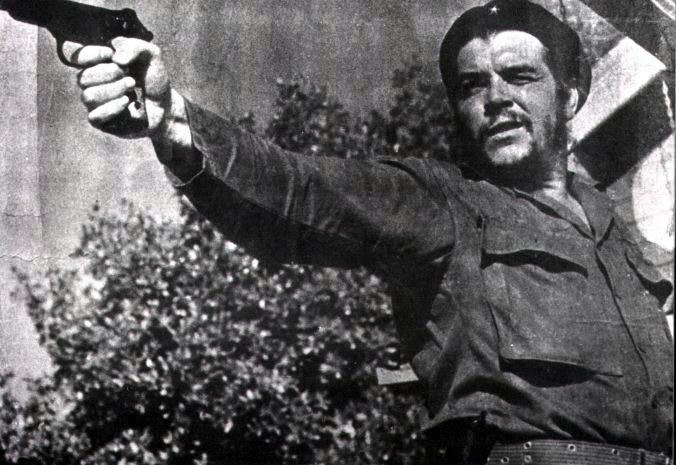
Che Guevara

From Wikipedia, the free encyclopedia.
Ernesto Rafael Guevara de la Serna (June 14, 1928 - October 9, 1967), commonly known as Che Guevara, was an Argentine-born Marxist revolutionary and Cuban guerrilla leader. “Che” is an Argentine expression for calling someone's attention, and in some other parts of Latin America, a slang for someone from Argentina.
Guevara was a member of Fidel Castro's 26th of July Movement, which seized power in Cuba in 1959. After the revolution Guevara became second only to Fidel Castro in the new government of Cuba. After a brief stints as president of the National Bank and Minister of Industries, Guevara did not settle in as part of the new Cuban government, and tried without success to stage revolutions through guerilla warfare in various countries, notably the Democratic Republic of the Congo and Bolivia, where he was captured by a unit of the Bolivian Ranger Battalion advised by United States Green Berets on October 8, 1967, and executed the following day.
Biography In 1951, Ernesto set off from his home town of Córdoba on a motorcycle tour of Central and South America. The poverty he observed during this trip led him to intensify his study of Marxist ideologies. Following his graduation from the University of Buenos Aires medical school in 1953, he travelled to Guatemala where a populist leader, Jacobo Arbenz Guzmán, had recently been elected president. Ernesto met several followers of Fidel Castro who were in exile there. When the CIA sponsored an overthrow of Arbenz's rule, Ernesto volunteered to fight. Arbenz told his supporters to leave the country, and Ernesto briefly took refuge in the Argentine consulate. After moving to Mexico City, he renewed his friendship with Castro's associates. Ernesto met Castro when the latter arrived in the Mexican capital after being amnestied from political prison in Cuba, and joined his 26th of July Movement dedicated to the overthrow of Cuban Dictator Fulgencio Batista.
Castro, Che and 80 other insurgents departed Tuxpan, Mexico aboard the cabin cruiser "Granma" in November 1956 to invade Cuba and start the revolution. The boat had been owned by an American, so the name most likely meant Grandma, as a tribute to the previous owner's grandmother. Shortly after disembarking in a swampy area near Niquero in South-East Cuba, the expeditionaries were attacked by Batista's forces. Only 12 rebels survived. Che, the group's physician, laid down his knapsack containing medical supplies in order to pick up a box of ammunition dropped by a fleeing comrade, a moment which he later recalled as marking his transition from doctor to combatant.. Within months he rose to the highest rank, Comandante (Major), in the revolutionary army. His march on Santa Clara in late 1958, where his column derailed an armored train filled with Batista's troops and took over the city, was the final straw that forced Batista to flee the country.
His execution of deserters and spies in the revolutionary army, have led some to consider Guevara a ruthless leader. However those persons executed by Guevara or on his orders were condemned for the usual crimes punishable by death at times of war or in its aftermath: desertion, treason or crimes such as rape, torture or murder. For example, Dwight D. Eisenhower signed orders for imprisoned troops that had deserted to be executed. In 1959, Che Guevara was appointed commander of the La Cabana Fortress prison. During his term as commander of the fortress from 1959-1963, he oversaw the execution of what some estimate to be approximately 500 political prisoners and regime opponents. Many individuals imprisoned at La Cabana, such as poet and human rights activist Armando Valladares, allege that Guevara took particular and personal interest in the interrogation, torture, and execution of some prisoners. In fact, when Che's column had captured enemy soldiers who had not committed crimes against the public, such as rape and torture, he would simply take their ammo and release them.
Unlike other leaders, he gave up all the trappings of privilege and power in Cuba in order to return to the revolutionary battlefield and, ultimately, to die. He persuaded Castro to back him in the first, covert Cuban involvement in Africa. Guevara desired to first work with the Simba (aka "Lumumbaist") movement in the former Belgian Congo (later Zaire and currently the Democratic Republic of the Congo), with the goal of overthrowing the government and installing a Communist regime. He rapidly discovered that having worked for a successful revolutionary leader does not make one a successful revolutionary leader.
U.S. Army Special Forces advisors working with the Congolese army were able to monitor Che's communications, arrange to ambush the rebels and the Cubans whenever they attempted to attack, and interdict Guevara's supply lines. Guevara proved unable to supplant the native Simba leadership, and in fact was forced to place his troops under Simba command. Every military operation planned by him failed miserably. Late that same year, ill, humiliated and with only a few survivors of the force he had brought into the country, Guevara left the Congo.
Following a lengthy recuperation in Cuba, traveling on a false passport Guevara entered Bolivia in November of 1966, again with the idea of organizing a revolt and hoping to topple Bolivia's pro-U.S. military government and installing a Communist government there. A parcel of jungle land in Nancahazu was purchased by native Communists and turned over to him for use as a training area. The evidence suggests that this training was more hazardous than combat to Guevara and the Cubans accompanying him. Little was accomplished in the way of building a guerrilla army. On learning of his presence in Bolivia, President Rene Barrientos is alleged to have expressed the desire to see Che's head displayed on a pike in downtown La Paz. He ordered the Bolivian Army to hunt Guevara and his followers down.
Che Guevara traveled to Bolivia in an attempt to aid a popular uprising there, but there are many factors which he simply did not predict. First of all, there was an American presence in Bolivia; after the U.S. government learned of his location, CIA operatives were sent into Bolivia to aid the anti-insurrection effort, and the anti-insurrectionists were being armed and trained by American officials. There was also the lack of help which Che had expected when he undertook the journey. For example, Fidel had told him that the communist party in Bolivia would aid him in the insurrection but they did not.